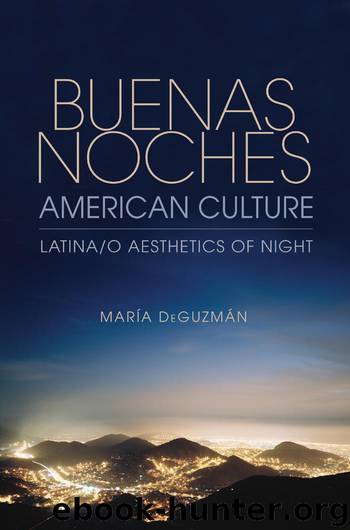
Buenas Noches American culture by María DeGuzmán
Author:María DeGuzmán
Language: eng
Format: epub
ISBN: 9780253001900
Publisher: Indiana University Press
CHAPTER FOUR
TRANSCULTURAL NIGHT WORK OF U.S.-BASED SOUTH AMERICAN CULTURAL PRODUCERS
On full moon nights, I sit alone near the piers, reaching across the waters to commune with my sisters. Each standing on her own pier, shore, or river’s edge, we extend outward our spiders’ webs until our thoughts meet and our spirits touch once more.
—Mariana Romo-Carmona, “The Web,” in Speaking Like an Immigrant:
A Collection (1998 first edition and 2010 second edition)
“Transcultural” is the adjectival form of “transculturation.” The latter term was originally coined in Spanish more than half a century ago by Cuban anthropologist and ethnographer Fernando Ortiz Fernández (1881–1969) to describe a bi-directional if not multi-directional convergence of different cultures that changes all cultures in the process, creating new hybridized cultures. He deliberately coined the term and elaborated the idea of “transculturation” as an alternate paradigm to coloniality, the dominant paradigm in the Americas including the United States, that assumes and attempts to enforce the acculturation and assimilation of what are deemed non-hegemonic nationalities, ethnicities, or cultures to what are deemed hegemonic ones.
Ortiz elaborated this paradigm of transculturation in his 1940 book on Cuban culture titled Contrapunteo cubano del tabaco y el azúcar and translated into English as Cuban Counterpoint: Tobacco and Sugar. Starting in the early 1990s and with intensifying critical attention in the twenty-first century, numerous scholars in Latin American, Latina/o, New Americas, empire, and postcolonial studies have adapted Fernando Ortiz’s paradigm of transculturation to their particular field of research and teaching. Take, for example, Mary Louise Pratt’s book Imperial Eyes: Travel Writing and Transculturation (1992), Frances R. Aparicio and Susana Chávez-Silverman’s edited volume Tropicalizations: Transcultural Representations of Latinidades (1997), Agustín Laó-Montes and Arlene Dávila’s Mambo Montage: The Latinization of New York (2001), Luis A. Ramos-García’s edited volume The State of Latino Theatre in the United States: Hybridity, Transculturation, and Identity (2002), Walter Mignolo’s article “Capitalism and Geopolitics of Knowledge: Latin American Social Thought and Latino/a American Studies” in Critical Latin American and Latino Studies, edited by Juan Poblete (2003), Alberto Sandoval-Sánchez and Frances R. Aparicio’s special issue of Revista Iberoamericana dedicated to “Hibridismos culturales: la literatura y cultura de los latinos en los Estados Unidos” (2005), and the section subtitled “Transcultural” from Gabriela Baeza Ventura’s anthology Latino Literature Today (2005). All, in various ways, call upon the concept of transculturation as a multi-directional crossing of cultures and cultural forms into one another across borders or boundaries to produce a contact zone comprising both lived experience and the representational forms that rhetorically and visually encapsulate these lived convergences and complexities.
I employ the terms “transcultural” and “transculturation” to showcase works by U.S.-based South American writers and one U.S.-based Peruvian photographer. I use the terms with specific reference to the ways in which these works—a collection of short stories, a volume of poems, a novel, and a series of photographs—extend, stretch, and break from the conventional boundaries of Latinidades. Their various challenges to the representational paradigms of Latinidades come first and foremost in a fundamental representation of Latinidades that does not use the United States as the main reference point for Latina/o identity.
Download
This site does not store any files on its server. We only index and link to content provided by other sites. Please contact the content providers to delete copyright contents if any and email us, we'll remove relevant links or contents immediately.
| African | Asian |
| Australian & Oceanian | Canadian |
| Caribbean & Latin American | European |
| Jewish | Middle Eastern |
| Russian | United States |
4 3 2 1: A Novel by Paul Auster(12356)
The handmaid's tale by Margaret Atwood(7732)
Giovanni's Room by James Baldwin(7303)
Asking the Right Questions: A Guide to Critical Thinking by M. Neil Browne & Stuart M. Keeley(5742)
Big Magic: Creative Living Beyond Fear by Elizabeth Gilbert(5728)
Ego Is the Enemy by Ryan Holiday(5395)
The Body: A Guide for Occupants by Bill Bryson(5066)
On Writing A Memoir of the Craft by Stephen King(4921)
Ken Follett - World without end by Ken Follett(4707)
Adulting by Kelly Williams Brown(4554)
Bluets by Maggie Nelson(4535)
Eat That Frog! by Brian Tracy(4502)
Guilty Pleasures by Laurell K Hamilton(4428)
The Poetry of Pablo Neruda by Pablo Neruda(4081)
Alive: The Story of the Andes Survivors by Piers Paul Read(4011)
White Noise - A Novel by Don DeLillo(3992)
Fingerprints of the Gods by Graham Hancock(3980)
The Book of Joy by Dalai Lama(3962)
The Bookshop by Penelope Fitzgerald(3829)
